
🌧️ Lecture on Precipitation
1. Introduction
Precipitation is a key component of the hydrological cycle. It represents the process by which water in the atmosphere falls to the Earth’s surface in liquid or solid form. Understanding precipitation is fundamental for hydrology, water resources engineering, agriculture, and climate studies.
2. Definition
Precipitation is defined as any form of water, liquid or solid, that falls from the atmosphere and reaches the ground. It occurs when atmospheric water vapor condenses and grows into droplets or ice crystals large enough to overcome air resistance and gravity.
3. Types of Precipitation
-
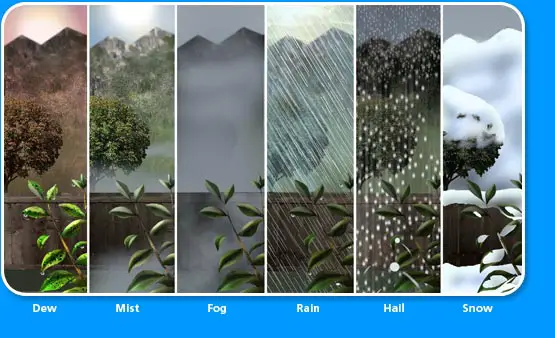
Rainfall – Liquid water droplets >0.5 mm diameter.
-
Drizzle – Very fine droplets <0.5 mm diameter.
-
Snow – Ice crystals formed directly from vapor deposition.
-
Sleet – Frozen raindrops that refreeze before reaching the surface.
-
Hail – Hard, spherical ice pellets formed in strong convective clouds.
-
Glaze / Freezing Rain – Rain that freezes upon contact with cold surfaces.
4. Mechanisms of Precipitation
-
Convective Precipitation – Caused by localized heating of the earth’s surface leading to rising air currents and thunderstorms.
-
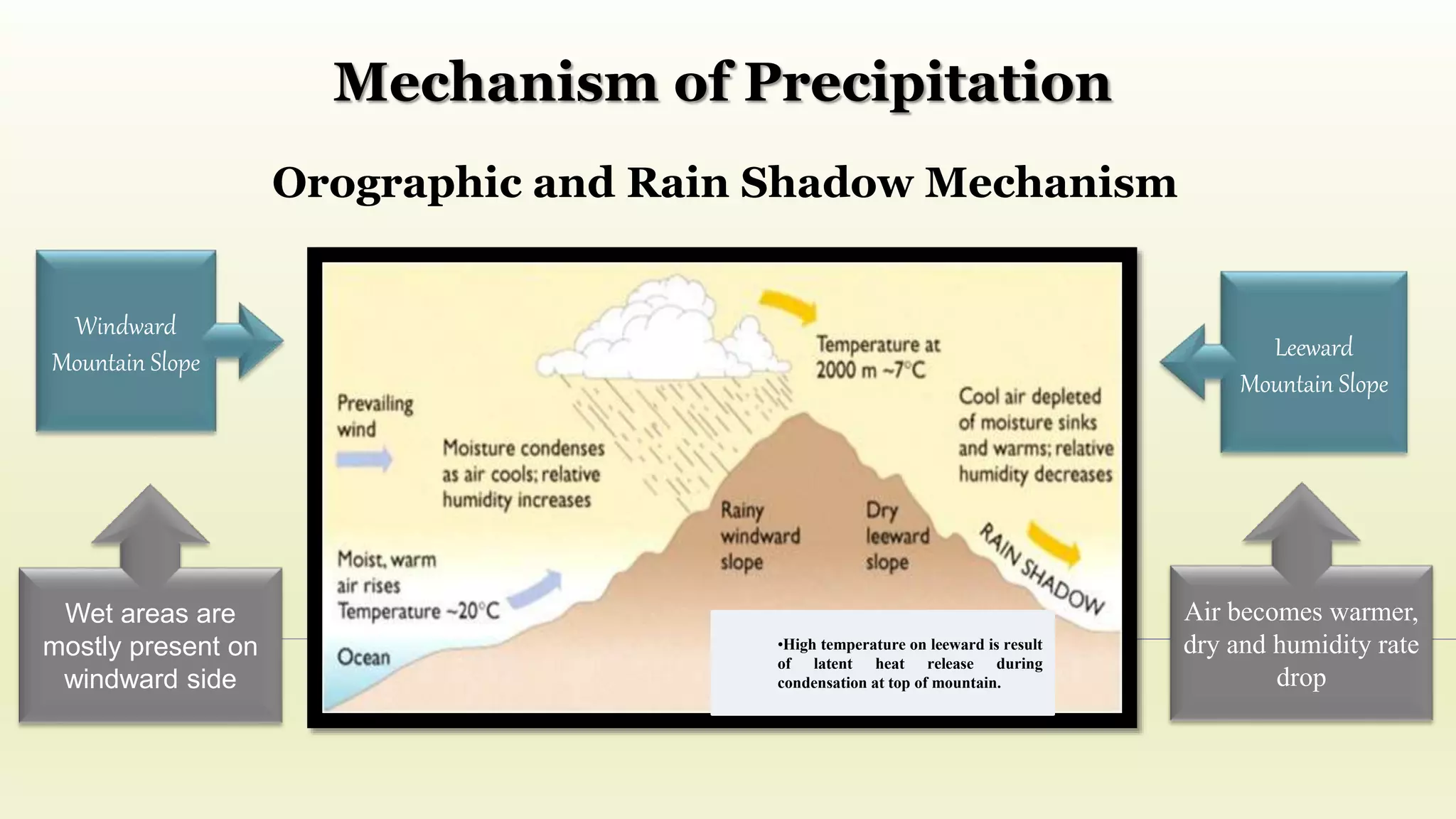
Orographic Precipitation – Occurs when moist air ascends a mountain slope, cools adiabatically, and condenses.
-
Cyclonic (Frontal) Precipitation – Produced when warm and cold air masses meet, causing lifting and condensation.
5. Measurement of Precipitation
-
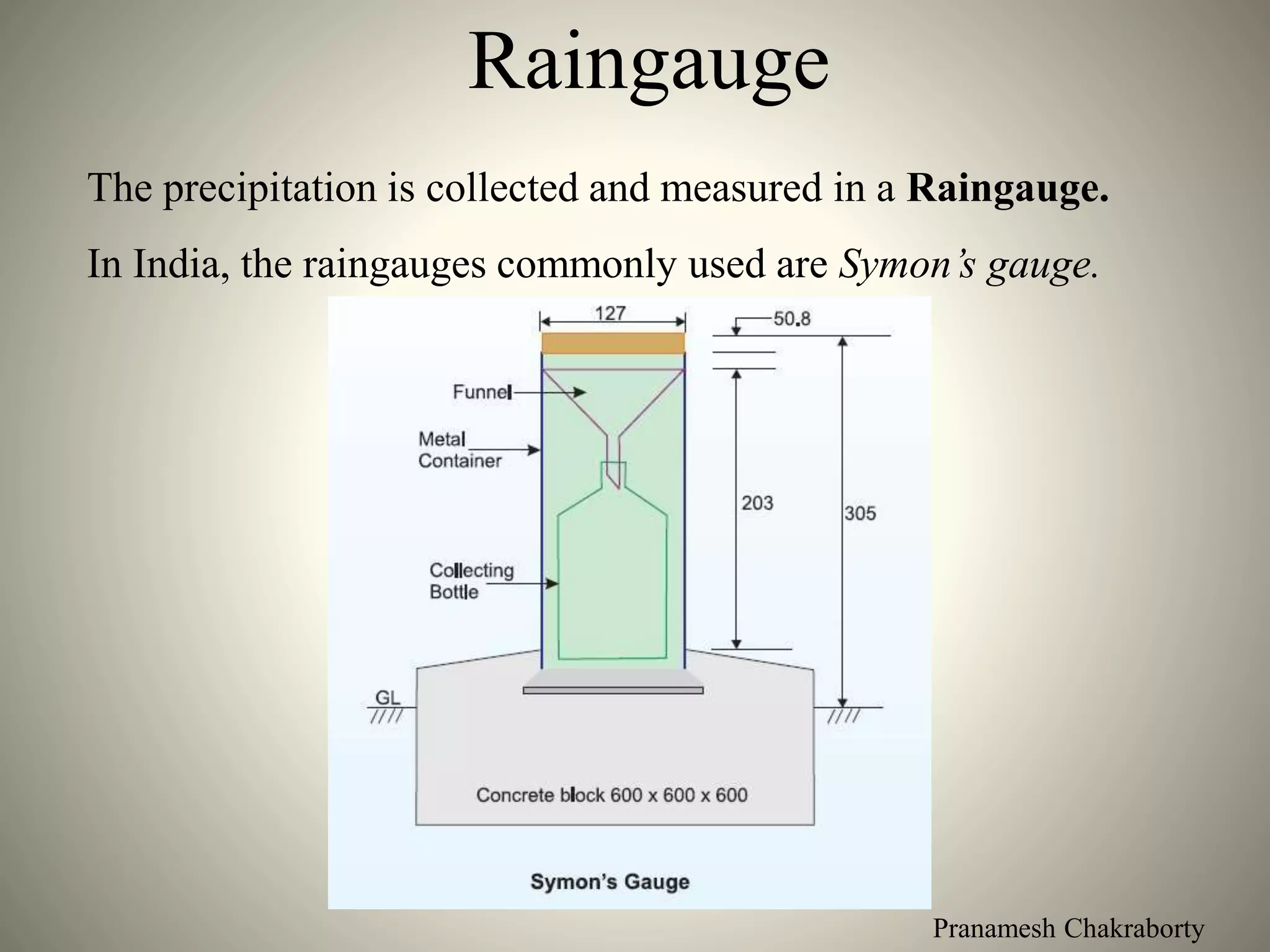
Rain Gauges – Non-recording (e.g., Symons rain gauge) and recording types (e.g., tipping bucket, weighing type).
-
Radar & Satellites – Used for large-scale monitoring.
-
Snow Gauges – Special devices for measuring solid precipitation.
6. Importance of Precipitation
-
Determines surface runoff and streamflow.
-
Governs groundwater recharge.
-
Vital for irrigation planning and agriculture.
-
Influences flood and drought forecasting.
-
Affects climate and ecosystem balance.
7. Key Engineering Applications
-
Design of Hydraulic Structures – Dams, spillways, stormwater drains.
-
Flood Risk Assessment – Return period analysis of extreme rainfall.
-
Water Supply Systems – Estimation of dependable rainfall.
-
Urban Drainage – Rainfall intensity-duration-frequency (IDF) analysis.
8. Conclusion
Precipitation is not only a natural phenomenon but also a critical design input for engineers, hydrologists, and planners. Accurate measurement and analysis ensure sustainable management of water resources and disaster mitigation.


0 Comments